Settings
 Fast Delivery
 Free Shipping
 Incoterms
 Payment Types


 Marketplace Product

How to Use Compact PLCs to Get Big Results in Green Energy, Building Automation, and Industrial Systems
Contributed By DigiKey's North American Editors
2025-12-19
Industrial network designers are being pressed to integrate traditional programmable logic controller (PLC) and industrial Internet of Things (IIoT) technologies in cramped spaces to support high performance in smaller automation and digitalization projects.
The controller must be compact but still able to bridge traditional automation with the IIoT and integrate information technology (IT) and operational technology (OT) networks. It needs a powerful dual-core processor, a microSD card slot, and at least 18 analog and digital I/O channels.
To maximize flexibility, the I/O should include an RS-485 serial port and a USB-C port for direct configuration connection. Some applications benefit from an optional CANopen communication port. To support OT and IT integration, it must have two Ethernet ports that can support two unique IP addresses, one for field-level devices and the second for SCADA or Cloud connectivity.
To expedite deployment, support for the CODESYS 3.5 integrated development environment (IDE) should be included, which allows users to build automation projects and systems quickly. Support for Docker containers in running open-source applications can further enhance flexibility and speed up deployment.
This article highlights the numerous capabilities of the WAGO Compact Controller 100 Series. It demonstrates how these controllers facilitate the rapid development and deployment of highly capable automation solutions for various applications, including building automation, battery energy storage, microgrids, industrial machines, green energy systems, and more.
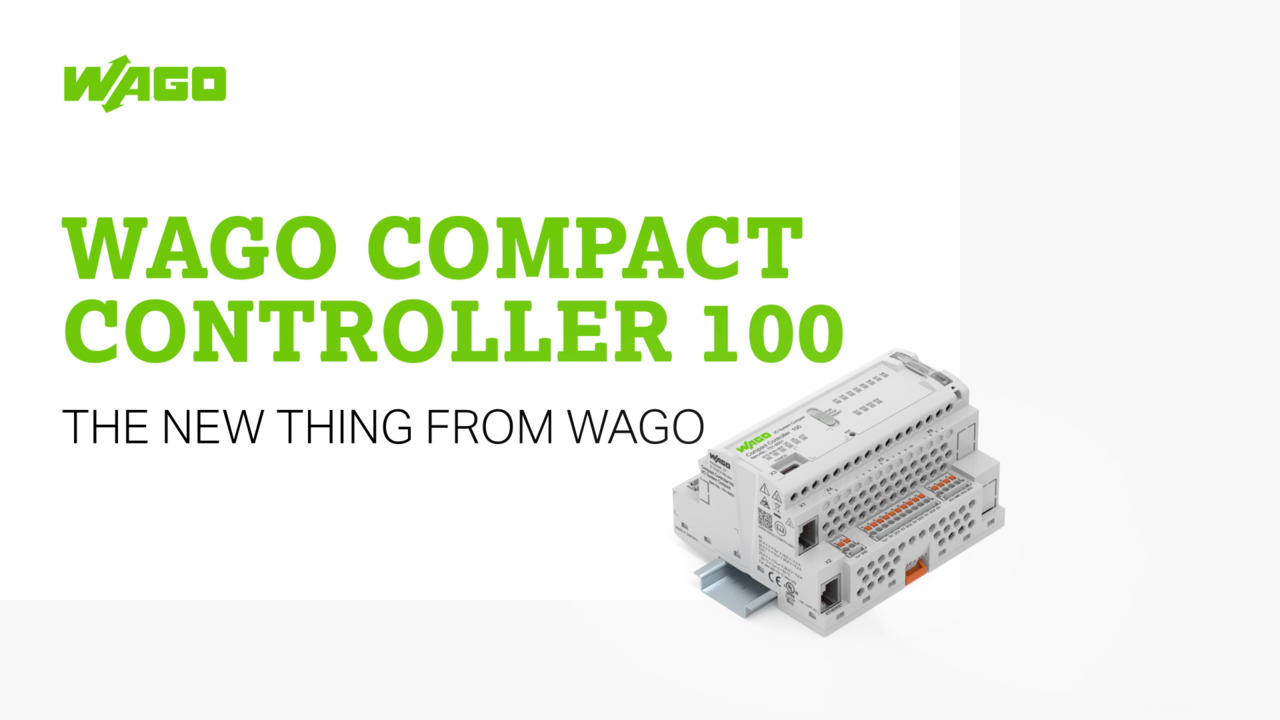
The Compact Controller 100 (CC100) PLCs measure only 55 mm (L) x 108 mm (W) x 90 mm (H) and fit in the palm of a hand. The diminutive dimensions significantly understate their powerful potential for digitizing a wide range of automation functions.
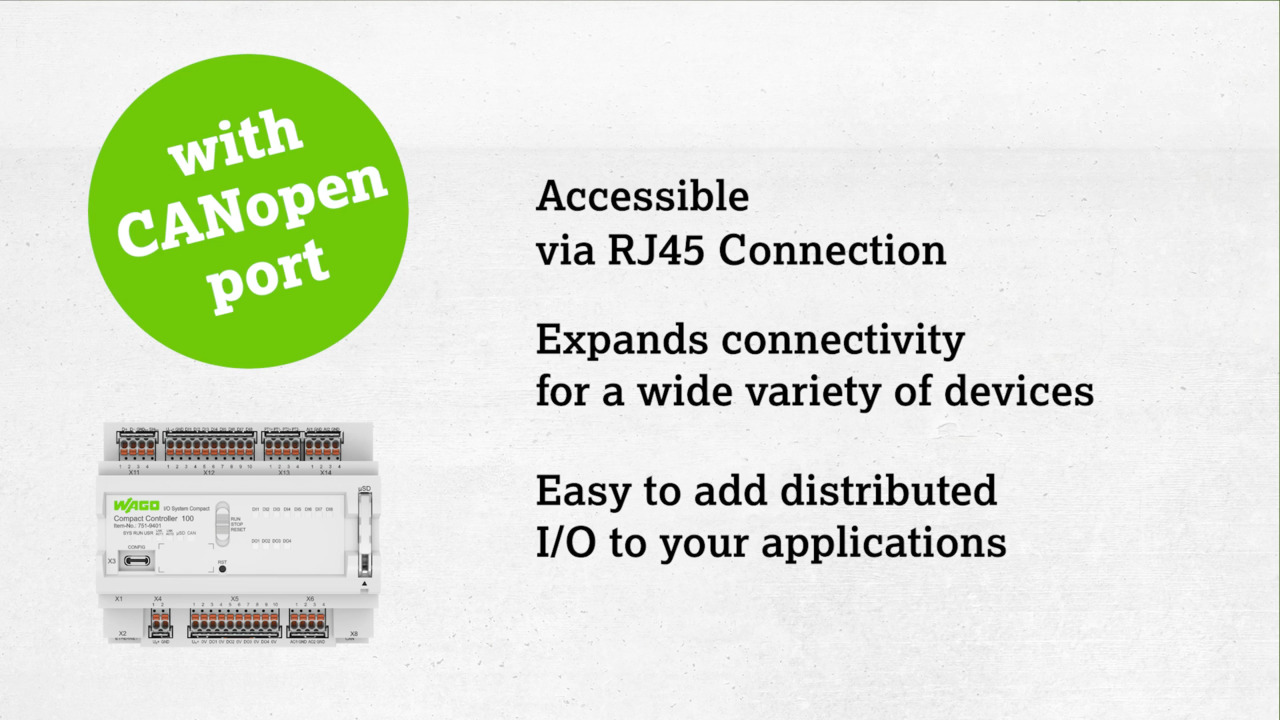
Does the application require up to four digital outputs, eight digital inputs, and up to two analog inputs and two analog outputs, an RS-485 interface for protocols such as Modbus RTU, and temperature inputs for platinum (Pt) or nickel (Ni) resistance sensors? Model 751-9301 has them. If the application also needs a CANopen connection, designers can use model 751-9401 (Figure 1).
 Figure 1: The CC100 model 751-9401 has the same mix of I/Os as model 751-9301, plus a CANopen interface (right-hand corner). (Image source: WAGO)
Can the application benefit from dual configurable Ethernet ports that can be used as a switch or for two separate IP addresses, supporting a dedicated connection to field and OT devices, as well as a separate connection to SCADA, IT, or Cloud systems? Plus, is there support for industrial Ethernet protocols like Modbus TCP/UDP, EtherNet/IP, and EtherCAT, and support for IIoT and cloud connectivity using protocols like MQTT?
Are cybersecurity features such as SSH, SSL/TLS encryption, a firewall, and network broadcast protection essential for securing the network? Both models in the CC100 series have all that, and more.
In addition to these important features and capabilities, the CC100 PLCs offer a USB programming port to simplify and speed up configuration, as well as a Micro SD card slot for firmware updates and other functions. As DIN-rail devices (per DIN 43880), both models can also be quickly mounted on small distribution boards.
Programming and power
To complete a basic installation, these PLCs require programming and power. Again, the CC100 series deliver big performance and possibilities. It can be programmed using CODESYS 3.5 in one or more of the IEC 61131-3 languages like Ladder Diagram (LD), Function Block Diagram (FBD), Sequential Function Chart (SFC), Structured Text (ST), and Instruction List (IL), or with options like Node-RED, C++, and Python.
The CC100 series supports Docker containers, enabling the running of additional applications and expanding their functionality. The built-in web server allows for the creation of HTML5 visualizations, facilitating easy operation and maintenance.
These PLCs can be enabled with utility-based protocols, including DNP3, used in electric and water utilities for monitoring and controlling remote equipment in SCADA systems. IEC61850 and IEC60870 are commonly used in electric substations, microgrid automation, and renewable energy and storage systems. Additionally, they support BACnet communications for building automation applications.
WAGO’s 787-2850 power supply delivers 1.25 A at 24 VDC and is the ideal power source for the CC100 series PLCs since it’s also designed to fit into compact installations (Figure 2). It features an electrically isolated output voltage that meets the requirements of safety extra-low voltage (SELV) and protective extra-low voltage (PELV) as per EN 61010-2-201/UL 61010-2-201, and an impressive MTBF of over 2.5 million hours at +40°C (per EN/IEC 61709).
 Figure 2: This 787-2850 power supply is well matched to the needs of CC100 PLCs. (Image source: WAGO)
Expansive possibilities
The integrated I/Os in the CC100 series provide a solid foundation, not a limitation, for implementing automation solutions. The I/O capacity can be expanded using combinations of 750 series I/O modules (over 500 are available) and I/O couplers.
For example, I/O module 750-1506 can be used to add eight digital inputs and eight digital outputs to basic CC100 PLCs. Various 750 couplers can be added to provide the required fieldbus connectivity. The coupler connects to the CC100 using an Ethernet cable and serves as a bridge, linking the CC100 to various fieldbuses.
For example, the 750-348 is a CANopen fieldbus coupler used to expand the I/O capacity of the CC100 by interfacing the modular WAGO 750 Series I/O system with a CANopen network (Figure 3). The 750-362 coupler supports connection with a Modbus network. Other couplers are available for EtherNet/IP or EtherCAT as a master.
 Figure 3: The 750-348 is a CANopen fieldbus coupler. (Image source: WAGO)
Once a coupler is connected, it’s a simple matter to use the CODESYS 3.5 software to program the PLC. The controller will then communicate with the I/O modules via the coupler to manage all the I/O points. The various couplers automatically detect all connected I/O.
For example, the 750-362 is a fourth-generation Modbus TCP/UDP fieldbus coupler. It translates signals from attached I/O modules (digital, analog, etc.) so they can communicate over a Modbus TCP/UDP network. It features two 10/100 Mbit/s Ethernet ports to support a daisy-chain topology, along with an integrated DIP switch for setting the IP address and an integrated web server for configuration and management.
Simple and powerful network management
CC100 is compatible with WAGO’s web-based management (WBM) software that provides a user interface for configuration, operation, and maintenance through a web browser using the CC100’s built-in web server and an Ethernet connection.
Users can develop and run HTML5 visualizations and manage secure access with features such as an integrated firewall, Transport Layer Security (TLS) encryption, and Virtual Private Network (VPN) capabilities, to protect against cyberattacks.
The HTML5 visualizations are hosted on the CC100 and can be remotely viewed on most web browsers. Basic information, such as controller status and system, network, and I/O states, can be viewed locally on the controller using integrated LED arrays.
WBM can also support network data management by facilitating the transfer of data to cloud solutions or utilizing protocols like MQTT to distribute data to other systems. The configuration for the cloud connection itself (like the cloud provider URL, security certificates, and authentication details) can be set up via the controller's WBM interface.
Cloud connections
With cloud connectivity, the CC100 can serve as a gateway for IIoT applications. The communication parameter is configured in the WBM, and the data to be exchanged between the cloud and controller is configured using the WAGOAppCloud library for CODESYS, which can handle tasks such as configuration details.
The CC100 can access the Internet via the built-in Ethernet interface and send the data to the cloud. Users can specify the cloud service to use, with Microsoft Azure, Amazon Web Services, and IBM Cloud available options (Figure 4).
 Figure 4: CC100 PLCs can reach the cloud using the MQTT protocol and an Ethernet connection. (Image source: WAGO)
Function blocks and libraries are available that abstract the complex communication processes (like establishing a secure connection, formatting data into JavaScript Object Notation (JSON) format, and handling data transfer) into simple, reusable code that can be called from within a standard IEC program.
The IEC application also allows users to select which control variables, like sensor readings or machine status, should be sent to the cloud. Users can control data flow and decide when and how data is sent, for example, event-driven transmissions versus periodic transmissions. The application can also implement pre-processing of data on the CC100, thereby reducing the required bandwidth for cloud connectivity.
Conclusion
The diminutive size of WAGO’s CC100 controllers belies their ability to support big performance in smaller automation and digitalization projects for a range of applications, including building automation, green energy, microgrids, electric and water utilities, and industrial systems. Their expandability also enables them to grow and adapt as requirements change. Their network management and cloud connectivity capabilities provide strong support for integrating IT and OT systems.
Recommended reading:
- Using Energy Storage Systems to Optimize Datacenter Reliability and Sustainability
- Optimizing Cable Management to Ensure Safety and Efficiency in Utility Scale PV Systems
- How Microgrids and DERs Can Maximize Sustainability and Resilience in Industrial and Commercial Facilities
- New PLCs Help Speed the Deployment of Complex and Critical Automation Processes
- How to Quickly Connect IoT Nodes to Amazon AWS and Microsoft Azure Clouds

Disclaimer: The opinions, beliefs, and viewpoints expressed by the various authors and/or forum participants on this website do not necessarily reflect the opinions, beliefs, and viewpoints of DigiKey or official policies of DigiKey.